
Understanding the Lifespan of Your Garage Door
The cost of repairing old garage door vs buying new is one of the most common questions homeowners face — and the answer depends on a few key factors.
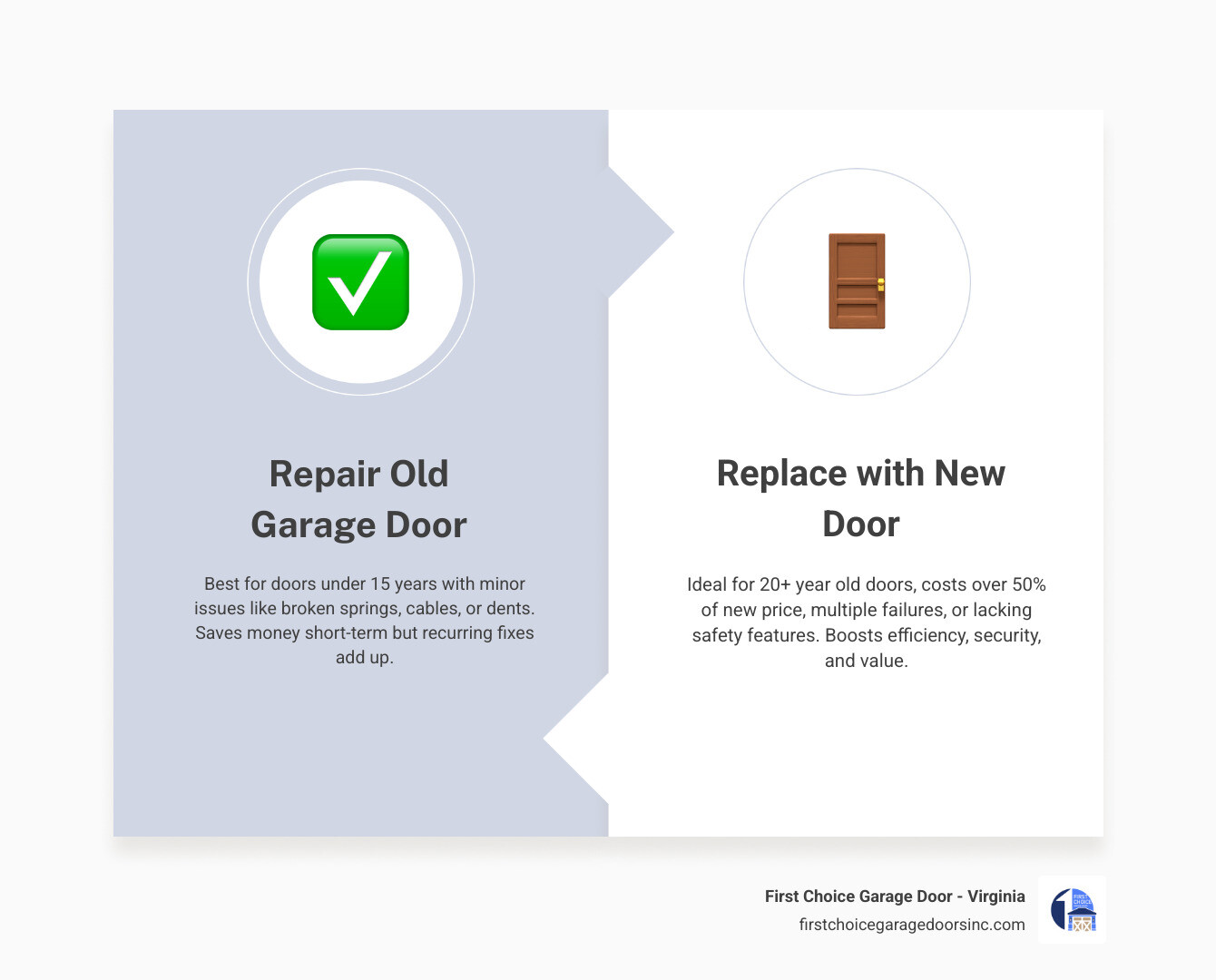
Here’s a quick breakdown to help you decide:
| Situation | Best Option |
|---|---|
| Door is under 15 years old, isolated damage | Repair |
| Single broken spring or worn cable | Repair |
| One dented panel on a newer door | Repair |
| Repair cost exceeds 50% of a new door’s price | Replace |
| Door is 20+ years old with recurring problems | Replace |
| Multiple damaged panels, luxury or structural issues | Replace |
| Door lacks modern safety features (pre-1993) | Replace |
Your garage door opens and closes thousands of times every year. It’s a major part of your home’s security, energy efficiency, and curb appeal — yet most homeowners only think about it when something goes wrong.
When that moment comes, the real question isn’t just “how much will this fix cost?” It’s whether putting more money into an aging door actually makes sense long-term — or whether a full replacement will save you more.
The good news? There’s a clear framework to help you decide. And for Northern Virginia homeowners, where seasonal temperature swings and humidity can accelerate wear, making the right call matters even more.
Before we can accurately weigh the cost of repairing old garage door vs buying new, we have to understand how much life that door likely has left. Generally, a high-quality garage door should last anywhere from 15 to 30 years. However, this is a broad range, and several variables can push your door toward the earlier or later end of that spectrum.
Material durability plays a massive role. Steel doors, which are incredibly popular in Northern Virginia, typically last 20 to 30 years because they resist the warping and rotting that can plague wood doors. Wood doors, while beautiful, often have a shorter functional lifespan of 15 to 20 years if they aren’t meticulously maintained with regular staining or painting.
Several factors are what is able to influence the longevity of your garage door. These include the quality of the initial installation, the frequency of use (the “cycle count” of your springs), and how often you perform basic maintenance like lubricating the tracks and rollers.
In our local Manassas and Northern Virginia climate, we also have to contend with high humidity and significant temperature shifts between winter and summer. These fluctuations cause materials to expand and contract, which can lead to hardware loosening or seals becoming brittle. There are many concerns with having an older garage door in this environment, as aged metal components are more prone to rust and fatigue when exposed to moisture over decades. If your door is pushing the 25-year mark, it’s often living on borrowed time.
When to Choose Repair: Scenarios for Saving Your Current Door
Choosing to repair isn’t just about being frugal; in many cases, it’s the most logical and efficient choice. If your door is relatively young — say, under 10 or 12 years old — and has been well-maintained, a repair is usually the way to go.
Most service calls we receive involve minor hardware failures. This includes things like snapped cables, worn-out rollers, or the classic broken torsion spring. These parts are designed to be replaced periodically, much like tires on a car. Identifying the signs you need a garage door repair, such as a door that moves slowly, makes excessive grinding noises, or feels heavy when operated manually, can help you catch issues before they turn into “replacement-level” problems.
Cosmetic wear is another area where repair shines. If a stray basketball or a minor bumper tap has dented a single section, you might wonder: the lone ranger: can you really replace just one garage door section? The answer is yes — provided that the manufacturer still produces that specific model and the rest of the door hasn’t faded so much that the new panel would look out of place.
Understanding how often a garage door repair may be needed is key to your household budget. If you find yourself calling us once every five years for a minor tune-up or a spring change, your door is likely a great candidate for continued repair.
The Cost of Repairing Old Garage Door vs Buying New: The 50% Rule
When we help homeowners navigate the cost of repairing old garage door vs buying new, we often utilize the “50% Rule.” It’s a simple but effective decision framework: If the estimate for a repair (or the total cost of multiple repairs needed at once) exceeds 50% of the price of a brand-new door, you are almost always better off replacing it.
Why? Because a repair only guarantees that one specific part will work. It doesn’t reset the clock on the rest of the aging components. When choosing between garage door repair or replacement, you have to look at the “rolling cost.” If you spend a significant amount today on a motor and a panel, but the springs and tracks are 20 years old, you may find yourself paying for another major service call in six months.
Consider this comparison:
| Feature | Frequent Repair Path | Full Replacement Path |
|---|---|---|
| Upfront Expense | Lower | Higher |
| Warranty | Usually 30-90 days on parts | Comprehensive multi-year or lifetime |
| Safety | Relies on old sensors/hardware | Modern sensors and auto-reverse |
| Aesthetics | Mismatched or faded panels | Instant curb appeal boost |
| Reliability | “Patchwork” peace of mind | Total reliability for 15+ years |
Applying the 50% rule helps you see the long-term value. Often, we find that homeowners who choose to replace an aging, problematic door end up spending less over a five-year period than those who keep paying for emergency service calls. It’s all about when to repair vs. replace your garage door to maximize every dollar spent.
Evaluating the cost of repairing old garage door vs buying new based on age
Age is perhaps the most honest indicator of whether a repair is a “good” investment. We generally view the 15-year mark as the tipping point. If your door is under 15 years old, we lean toward repair. If it is over 15, we start looking at the structural integrity and part availability.
Knowing when is it time to have a garage door replacement? often comes down to the “cascading failure” effect. On a door that is 20 years old, the metal tracks may be slightly warped, the hinges may be brittle, and the opener may lack modern rolling-code security. At this stage, repairing one thing often puts stress on another. If you notice signs you need a garage door replacement like visible sagging when the door is open, excessive vibration, or deep-seated rust at the bottom of the panels, it’s a signal that the structural integrity is compromised.
Analyzing the cost of repairing old garage door vs buying new for energy efficiency
One factor that many Northern Virginia homeowners overlook is the impact on their utility bills. Older doors, especially those manufactured 20+ years ago, often have little to no insulation. They act as a massive “thermal bridge,” allowing freezing air into your home during a Virginia winter and trapping heat during our humid summers.
There are many reasons to get a new garage door that go beyond just mechanical function. Modern doors come with much higher R-values (a measure of thermal resistance). An insulated door can keep your garage 10 to 20 degrees warmer in the winter, which is a huge benefit if you have a bedroom above the garage or use the space as a workshop.
The perks of getting a garage door replacement include lower energy bills and a more comfortable home. New doors also feature advanced weather seals and “thermal breaks” that old doors simply don’t have. When you factor in the energy savings over the next 15 years, the “cost” of the new door begins to pay for itself.
Maximizing Your Return on Investment (ROI)
If you are planning to sell your home in the next few years, the cost of repairing old garage door vs buying new becomes an investment calculation. Year after year, the “Cost vs. Value” report (a major industry study) ranks garage door replacement as one of the top home improvement projects for ROI. In 2025, reports showed that homeowners can recoup a massive portion of the cost — sometimes even exceeding 100% — in added home resale value.
But why get a new garage door? It’s about more than just the numbers; it’s about curb appeal. The garage door can make up nearly one-third of your home’s front facade. A dented, peeling, or outdated door sends a message to buyers that the home hasn’t been well-maintained. Conversely, a modern carriage house or sleek contemporary door creates an instant “wow” factor.
There are at least 5 reasons to have a new garage door installed before listing your home:
- Instant Curb Appeal: It refreshes the entire look of the house.
- Security: New openers feature anti-hacking technology.
- Safety: Modern doors are lighter and have better sensors.
- Quiet Operation: New hardware and belt-drive openers are whisper-quiet.
- Low Maintenance: Modern finishes require much less work than old wood or thin steel.
Frequently Asked Questions about Garage Door Decisions
How long do garage doors typically last in Virginia?
In Virginia, you can expect a steel door to last 20 to 30 years and a wood door to last about 15 to 20 years. However, the salt used on roads in Northern Virginia during winter can accelerate rust on the bottom of steel doors if they aren’t cleaned. Regular maintenance is the biggest factor in what is able to influence the longevity of your garage door. We recommend a professional tune-up at least once a year to ensure the hardware is holding up against our local weather.
What are the hidden benefits of a full replacement?
Beyond the obvious look of the door, the perks of getting a garage door replacement include smart technology integration. Most new systems allow you to monitor and close your door from your smartphone, providing peace of mind when you’re at work or on vacation. Additionally, safety features have come a long way. Doors made before 1993 lack the required auto-reverse sensors that prevent the door from closing on a child, pet, or vehicle. Upgrading literally saves lives.
When should I consult a professional for an assessment?
You should call us the moment you notice a change in how the door sounds or moves. If you’re going through the ultimate checklist of garage door warning signs and checking off things like “frayed cables,” “shaking during operation,” or “uneven closing,” it’s time for a pro.
When comparing a DIY vs. professional garage door repair, garage springs are under enough tension to cause serious injury. While a homeowner can certainly lubricate a track, any work involving the springs, cables, or door balance should always be handled by an expert.
Conclusion
Deciding between the cost of repairing old garage door vs buying new doesn’t have to be a guessing game. By using the 50% rule, considering the age of your door, and looking at the potential ROI, you can make a choice that protects both your home and your wallet.
At First Choice Garage Doors, we’ve spent years helping Northern Virginia neighbors in Manassas and beyond find the perfect balance between fixing what’s broken and investing in the future. Whether you need a precision repair to get your door back on track or a stunning new installation to transform your home’s exterior, our team is here to provide expert, stress-free service.
Ready to find out which option is right for you? More info about garage door repair services is just a click away, or give us a call for a professional assessment of your door’s condition.